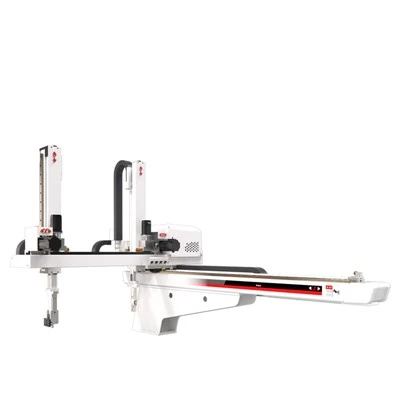
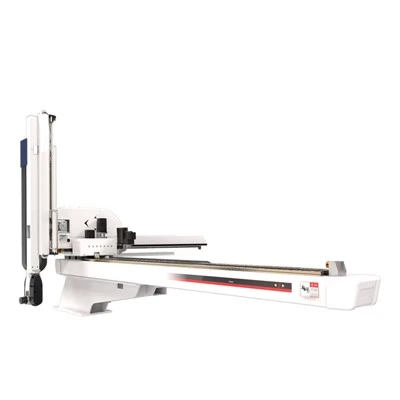
RBTIC injection molding robots automate part removal, sprue separation, and transfer from injection molding machines – with configurations matched to tonnage, mold dimensions, part weight, stroke, and cycle time for seamless integration with downstream equipment.


Technical Specifications
|
Model |
BRTV09WDS5P0/F0 |
BRTV13WDS5P0/F0 |
|
Power Source(kVA) |
3.4 |
3.4 |
|
Recommended(ton) |
120T–320T |
320-700T |
|
Drive Type |
AC Servo Motor |
AC Servo Motor |
|
Fixture Configuration |
Two suctions Two fixtures |
Two suctions Two fixtures |
|
Traverse Stroke(mm) |
Overall cross beam length ≤6000mm |
Overall cross beam length ≤6000mm |
|
Crosswise Stroke(mm) |
TBC |
TBC |
|
Vertical Stroke(mm) |
900 |
1300 |
|
Max.loading(kg) |
5 |
8 |
|
Dry Take Out Time(sec) |
1.7 |
2.3 |
|
Dry Cycle Time(sec) |
TBC |
TBC |
|
Air Consumption(NI/cycle) |
9 |
9 |
|
Repeatability(mm) |
±0.05 |
±0.05 |
|
Weight(kg) |
Non Standard |
Non standard |

How Does an Injection Molding Robot Work?
An injection molding robot works with the molding machine to remove finished parts from the mold and transfer them to a designated location.
Typical operating sequence
Mold Opening: The robot enters the working area when the required machine conditions are met.
Part Picking: The end-of-arm tooling grips or picks up the molded part.
Part Removal: The robot withdraws the part from the mold area.
Part Placement: The part is placed on a conveyor, fixture or designated collection point.
Return to Position: The robot returns to its standby position for the next molding cycle.
Key Components
Robot Arm: Provides the required movement and reach.
Drive System: Controls the robot's movement according to its design.
Controller: Coordinates robot actions and relevant machine signals.
End-of-Arm Tooling: Handles parts according to their shape, weight and surface requirements.
Safety and Interface Components: Support integration with the molding machine and surrounding equipment.
Applications of Injection Molding Robots
Injection molding robots can be configured for different plastic part handling tasks across manufacturing industries.
Automotive Plastic Components:Support the removal and transfer of molded housings, interior components and other plastic parts, subject to payload and tooling requirements.
Consumer Electronics:Handle plastic enclosures, covers and small molded components where controlled gripping and consistent placement are required.
Household Plastic Products:Automate the removal and collection of molded containers, appliance components and other household plastic products.
Packaging Components:Support the handling of molded caps, closures and other plastic packaging components when the robot configuration meets the required cycle time.
Precision Molded Parts:Use application-specific tooling and handling settings to help protect part surfaces and maintain consistent transfer operations.
Custom Injection Molding Robot Integration
Different molding applications may require specific tooling, installation arrangements and downstream connections. The configuration should be confirmed before production.
Custom End-of-Arm Tooling: Grippers or vacuum-based tooling selected according to part geometry, weight and surface requirements.
Machine Interface: Assessment of control signals, operating sequences and safety interlocks.
Conveyor Integration: Part transfer to conveyors or designated collection stations where supported.
Part Orientation and Placement: Handling arrangements for required part orientation, sorting or stacking.
Production Line Integration: Evaluation of available space, cycle time and connections with existing automation equipment.
Quality Control and Testing
Component Inspection
Checking specified mechanical and electrical components.
Assembly Inspection
Verifying assembly accuracy and installation of key components.
Functional Testing
Checking robot movements, control functions and operating sequences.
Application Testing
Evaluating part handling under agreed test conditions where applicable.
Pre-Shipment Inspection
Confirming the agreed product configuration and documentation before delivery.
Ordering, Delivery and Technical Support
Order Confirmation: Robot model, specifications, tooling, machine compatibility (120–700T), and accessories confirmed before order.
Production & Delivery: 15–30 working days for standard models; 30–45 days for customized configurations.
Installation & Commissioning: Installation instructions and commissioning assistance provided; on-site service available on agreement (typically 1–3 working days).
Spare Parts & Maintenance: Key wear parts (grippers, suction cups, guide rails) stocked for quick dispatch, with maintenance procedures and documentation.
Warranty & After-Sales: 12-month warranty; remote technical assistance, online troubleshooting, and on-site technician dispatch when required.
FAQ
Q: What information is required for a quotation?
A: Machine brand and model, clamping force, part dimensions/weight, mold layout, required operations, cycle time, quantity, and destination country.
Q: What is the production lead time?
A: Standard: 15–30 working days. Customized: 30–45 working days. Confirmed in quotation or purchase agreement.
Q: What payment terms are available?
A: 30% T/T deposit, 70% balance before shipment.
Q: Can I obtain technical drawings before purchase?
A: Yes – datasheets, dimensional drawings, electrical requirements, and installation documentation available for the selected model.
Hot Tags: injection machine robot, China injection machine robot manufacturers, suppliers, factory