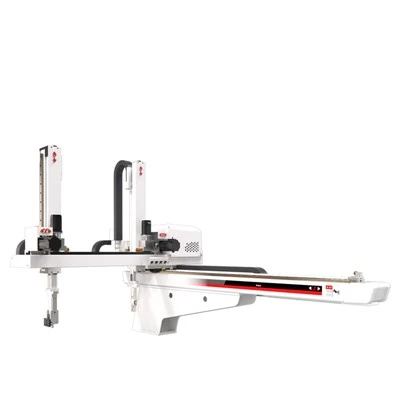
Our Plastic Injection Robot series delivers high-speed part extraction, precise insert loading, and versatile secondary handling for single- and multi-cavity production lines – engineered for speed, flexibility, and 24/7 operational reliability.


Parameters
|
Model |
BRTN17WSS3PC |
BRTN17WSS5PC |
|
Power Source(kVA) |
4.23 |
4.23 |
|
Recommended I.M.M(ton) |
600T–1700T |
600T–1700T |
|
Drive Method |
AC Servo motor |
AC Servo motor |
|
Model of EOAT |
Four suctions Two fixtures |
Four suctions Two fixtures |
|
Traverse Stroke(mm) |
2510 |
2510 |
|
Crosswise Stroke(mm) |
1415 |
1415 |
|
Vertical Stroke(mm) |
1700 |
1700 |
|
Max.Payload(kg)) |
20 |
20 |
|
Dry Take Out Time(sec) |
4.45 |
4.45 |
|
Dry Cycle Time(sec) |
13.32 |
13.32 |
|
Air Consumption(NI/cycle) |
15 |
15 |
|
Repeatability(mm) |
±0.1 |
±0.1 |
|
Weight(kg) |
585 |
585 |

Core Product Capabilities & Technical Advantages
Ultra-Fast Extraction: Lightweight aluminum/carbon-fiber arms enable takeout times as low as 0.6 seconds.
Flexible Multi-Axis Control: 3-axis, 5-axis, and hybrid pneumatic/servo configurations for complex geometries.
Custom EOAT: Multi-circuit pneumatic/vacuum lines support quick-change suction, gripping, sprue cutting, and insert placement.
Vibration Reduction: Digital suppression minimizes arm wobble at high speeds – protecting molds and delicate parts.
Smart Safety: Real-time torque monitoring and optical barriers prevent mold collisions during misfeeds or power loss.
Plastic Parts and Handling Applications
Small Components: Compact grippers with controlled handling to prevent displacement, damage, or mixing.
Thin-Walled/Lightweight Parts: Careful control of gripping force, contact area, and release position – based on rigidity and deformation risk.
Large Components: Higher payload, greater range, or different gripping – reviewing weight, dimensions, mold space, and placement position.
Parts with Runners: Confirm whether parts and runners are removed together or separately – gripper and motion sequence depend on mold and process.
Downstream Handling: Define orientation, release position, and transfer sequence before finalizing – for conveyor, fixture, inspection, or next workstation.
Gripper Configuration for Plastic Part Handling
Part Geometry: Gripping points must match the molded component's shape and available contact surfaces.
Part Material & Rigidity: Thin-walled, flexible, or easily marked parts may need different contact arrangements from rigid components.
Gripping Method: Mechanical, vacuum, or other methods selected according to the part and confirmed equipment capabilities.
Runner Handling: Confirm required gripping points and whether separate handling is needed when runners must also be removed.
Product Orientation: Evaluate whether additional movement or tooling is required if the part must be rotated or placed in a specific orientation.
Changeover Needs: For multiple products, consider dedicated grippers, adjustable tooling, or quick-change arrangements.

Quality Assurance and Acceptance Criteria
Precision & Repeatability Test: Multi-axis positioning verified to ±0.05 mm accuracy over 1,000 continuous cycle runs.
Load & Speed Verification: Stress-tested under maximum rated payload capacity and peak dry-cycle speeds prior to delivery.
Safety & Interlock Validation: Comprehensive inspection of Euromap emergency stop handshakes, pneumatic pressure sensors, and physical limit switches.
Pre-Shipment Factory Run-Off (FAT): Full functional and electrical audit conducted to guarantee plug-and-play reliability upon on-site installation.
Packaging & Shipping Standards
Industrial Export Crating: Securely packed in ISPM 15-compliant fumigated wooden crates with reinforced internal bracing to prevent transit shifting.
Moisture & Shock Protection: Sealed in heavy-duty moisture barrier foil with desiccants and shock-absorbing foam cushioning for critical electronics.
Component Kit Organization: Clearly labeled modular parts, cables, and EOAT fixtures sorted into dedicated sub-boxes for rapid on-site unpacking.
Global Logistics Support: Full compliance with international export standards, including complete customs documentation, insurance coverage, and reliable sea/air freight tracking.
FAQ
Q: How can I reduce the risk of damaging plastic parts during removal?
A: Evaluate gripping method, contact points, gripping force, motion path, and release position against the part's geometry and material characteristics – application testing may be needed for sensitive components.
Q: What information is required to check robot compatibility?
A: Provide machine manufacturer and model, clamping force, mold dimensions, installation height, machine interface details, and available floor or ceiling clearance.
Q: Can the robot meet my existing production cycle time?
A: Assessed against actual payload, travel distance, gripping sequence, machine timing, and safety requirements – request verified performance data for the proposed configuration and application.
Q: What payment terms are available?
A: 30% T/T deposit, 70% balance before shipment.
Hot Tags: plastic injection robot, China plastic injection robot manufacturers, suppliers, factory