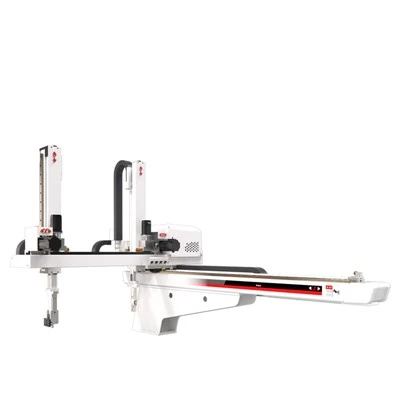
RBTIC Robots for Injection Molding are 3-axis servo manipulators designed for automatic removal of molded plastic parts and sprues from injection molding machines. The BRTNG09WSS3P/F and BRTNG11WSS3P/F models support part extraction, separation and transfer for automated molding production.


Technical Specifications
|
Parameter |
BRTNG09WSS3P/F |
BRTNG11WSS3P/F |
|
Recommended Machine Tonnage |
160–380 T |
250–480 T |
|
Drive Type |
AC Servo Motor |
AC Servo Motor |
|
Maximum Payload |
2 kg |
2 kg |
|
Traverse Stroke |
1,500 mm |
1,700 mm |
|
Crosswise Stroke |
600 mm |
700 mm |
|
Vertical Stroke |
950 mm |
1,150 mm |
|
Dry Take-Out Time |
0.68 s |
0.68 s |
|
Dry Cycle Time |
4.07 s |
4.07 s |
|
Repeatability |
±0.05 mm |
±0.05 mm |
|
Power Capacity |
3.23 kVA |
5.38 kVA |
|
Air Consumption |
3.2 NL/cycle |
3.2 NL/cycle |
|
Robot Weight |
300 kg |
330 kg |
|
Fixture Configuration |
Two suction points, two fixtures |
Two suction points, two fixtures |

High-Speed Part Removal
Fast Take-Out
The 0.68-second dry take-out time helps remove molded parts quickly, reducing robot handling time between molding cycles.
Repeatable Pickup
±0.05 mm repeatability helps the robot return to programmed pickup positions consistently during repetitive production.
Servo-Controlled Motion
AC servo motors control traverse, crosswise and vertical movement, supporting accurate execution of the programmed extraction path.
Machine Compatibility
BRTNG09WSS3P/F: Recommended for 160–380 T injection molding machines.
BRTNG11WSS3P/F: Recommended for 250–480 T injection molding machines.
Installation Fit: Final compatibility depends on mold opening space, tie-bar clearance, mounting dimensions and the required extraction path.

Applications
Automotive Plastic Components: Removes molded plastic parts from the mold for collection or downstream assembly.
Electronic Housings: Extracts TV frames and similar molded enclosures for inspection or subsequent processing.
Consumer Plastic Parts: Handles components such as water-bottle handles after molding.
Part and Sprue Separation: Transfers molded parts and sprues for separate collection where the mold and fixture arrangement supports this process.
Why Choose RBTIC?
Manufacturing Base: 12,000 m² facility in Dongguan, supporting robot integration and project assembly.
Project Experience: More than 1,000 completed projects across industrial automation applications.
Engineering Support: CAD/3D simulation review, technical communication and remote or on-site commissioning support.
Robot Integration: Cooperation with BORUNTE supports the integration of robotic arms into application-specific automation systems.
Testing and Warranty: Workcell assembly, programming and trial runs are completed before dispatch. A 12-month warranty is provided.
Information Required for Quotation
Injection Molding Machine: Brand, model and clamping force to identify the suitable robot model.
Mold and Installation: Mold dimensions, opening space and layout drawing to assess access and mounting fit.
Molded Part: Dimensions, weight, material and cavity count to determine handling and fixture requirements.
Removal Process: Whether sprues require separate handling and where parts must be transferred.
Production Target: Required cycle time and operating sequence to define the automation scope.
Installation and Project Integration
Installation layout is based on the selected model's mounting dimensions and travel range.
Robot entry, part extraction and exit paths are planned around mold opening space and surrounding equipment.
Robot movements are coordinated with the injection molding machine's operating sequence through the agreed control interface.
Suction points and fixtures are matched to the molded part's geometry, weight and gripping surface.
FAQ
Q: Can one injection molding robot handle different plastic part types?
A: Yes, if the parts fall within the robot's payload and working range. Different part shapes may require separate grippers or program adjustments.
Q: What spare parts should be prepared for an injection molding robot?
A: Ask the supplier for a model-specific spare-parts list based on operating hours, maintenance requirements and expected production demand.
Q: What support is available if the robot stops during production?
A: Confirm remote troubleshooting, on-site service availability and spare-parts supply arrangements before placing the order.
Q: What should be agreed on before robot commissioning?
A: Define commissioning responsibilities, acceptance criteria, production conditions and the required handover documents before installation begins.
Q: Can an injection molding robot be integrated with a conveyor or inspection system?
A: Yes, subject to controller interfaces, communication requirements and the layout of the surrounding equipment. Confirm integration scope before ordering.
Q: What training should operators receive after installation?
A: Training should cover normal operation, program selection, alarm handling, basic maintenance and applicable safety procedures.
Hot Tags: robots for injection molding, China robots for injection molding manufacturers, suppliers, factory