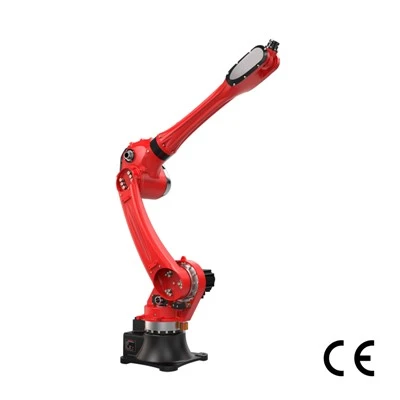
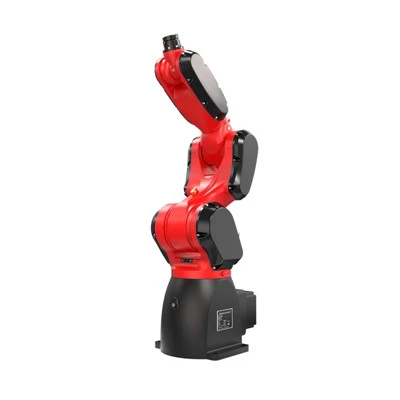
The RBTIC BRTIRUS1510A is a six-axis industrial robot designed for automated welding of metal components and fabricated assemblies. With a 10 kg payload, 1,587 mm arm reach and ±0.05 mm repeatability, it supports programmed welding paths for batch production and multi-angle joint access.
Technical Specifications
|
Parameter |
Specification |
|
Model |
BRTIRUS1510A |
|
Number of Axes |
6 |
|
Rated Payload |
10 kg |
|
Arm Reach |
1,587 mm |
|
Repeatability |
±0.05 mm |
|
Power Capacity |
5.06 kVA |
|
Power Supply |
220 V |
|
Control System |
HC Control System |
|
Robot Weight |
152 kg |
|
J1 Motion Range / Max. Speed |
±165° / 190°/s |
|
J2 Motion Range / Max. Speed |
-95° to +70° / 173°/s |
|
J3 Motion Range / Max. Speed |
-85° to +75° / 223°/s |
|
J4 Motion Range / Max. Speed |
±180° / 254°/s |
|
J5 Motion Range / Max. Speed |
±115° / 270°/s |
|
J6 Motion Range / Max. Speed |
±360° / 342°/s |
System Integration
Welding Equipment: Welding power source, welding torch, wire feeder and torch cleaning unit.
Workpiece Positioning: Welding fixtures, rotary positioners and headstock-tailstock positioners.
Robot Control: Robot controller, welding process controller, PLC and I/O communication modules.
Safety Equipment: Safety fencing, light curtains, safety interlocks and emergency-stop devices.
Material Handling: Conveyor systems, loading and unloading stations, and workpiece transfer units.
Welding Cell Accessories: Torch cable management, cable dress packs and fume extraction systems.
Welding Performance
Fast Repositioning: Axis 6 reaches a maximum speed of 342°/s, helping shorten torch repositioning time between welds and reduce non-welding movement time.
Repeatable Torch Positioning: ±0.05 mm repeatability supports consistent programmed torch positioning across repeated welding cycles, reducing positional variation between parts.
Multi-Angle Welding: Six-axis articulation and ±360° Axis 6 rotation allow the torch to approach joints from different orientations, reducing the need to reposition workpieces for accessible welds.
Work Envelope & Installation Planning
Reach and Coverage: The 1,587 mm arm reach helps define the initial workstation layout. Final coverage depends on mounting position, robot posture, workpiece dimensions and fixture placement.
Mounting and Clearance: Check the robot's installation drawing, base dimensions, axis movement limits and surrounding equipment clearance before fixing the mounting position.
Torch and Fixture Access: Simulate the planned welding paths with the actual torch, cables and fixtures to identify inaccessible joints and potential collisions before installation.


Applications
Electrical Cabinet Frames: Welding corner joints, frame seams and mounting brackets on power distribution cabinets and control enclosures.
Stainless Steel Tube Structures: TIG welding tube-to-tube joints, crossbeams and support brackets for equipment frames and storage racks.
Machinery Frames & Bases: Repetitive fillet and butt welding on machine bases, support frames and welded steel assemblies.
Metal Furniture Frames: Welding joints on table frames, chair structures, shelving units and other tubular or profile-based furniture.
Pipe & Flange Assemblies: Welding pipe-to-flange connections and circumferential joints when suitable workpiece positioning equipment is used.

Quality Control & Inspection
Repeatability Verification: Run repeated positioning tests at specified test points and record the measured deviation against the ±0.05 mm repeatability requirement.
Axis Motion Test: Operate all six axes through the specified movement ranges. Record motion errors, abnormal vibration and controller alarms.
Welding Trial: Weld representative workpieces using agreed process parameters. Check bead appearance, continuity, weld dimensions and defects against the approved acceptance criteria.
Weld Inspection: Use visual inspection as the baseline; apply penetrant, magnetic particle or radiographic testing when required by the material, joint and project specification. Record results against the applicable acceptance criteria.
Pre-Shipment Inspection: Verify the model, controller, supplied accessories, electrical requirements and configured functions against the purchase order before dispatch.

Ordering & Technical Support
Minimum Order: 1 unit.
Quotation Requirements: Provide workpiece drawings, material and thickness, joint type, weld length, production volume and target cycle time for project assessment.
Supply Scope: Specify robot-only delivery or a complete welding cell, including the required welding equipment, fixtures, positioners, safety devices and automation modules.
Delivery & Documents: Confirm lead time, packaging, shipping terms, commercial invoice, packing list and applicable technical documentation in the quotation.
Commissioning & Training: Define the required installation guidance, programming support, operator training and commissioning scope before ordering.
Spare Parts & Service: Confirm spare-part availability and technical support scope according to the selected model and supply agreement.


Structural Steel Fabricati

Metal Parts & Industrial Components

Pressure Vessels & Storage Tanks

Aluminum & Stainless Steel Fabrication


FAQ
Q: Can the BRTIRUS1510A weld carbon steel and stainless steel?
A: Yes, with a suitable welding process, power source and filler material. The configuration depends on material grade, thickness, joint design and weld quality requirements.
Q: Is the BRTIRUS1510A suitable for small-batch production?
A: Yes, when welding programs and fixtures can be adapted to different workpieces. Changeover time depends on part variation, fixture design and reprogramming requirements.
Q: How many parts can a welding robot produce per shift?
A: Output depends on weld length, welding speed, loading time, fixture arrangement and weld count per part. Estimate the full cycle, including loading, positioning, welding and unloading.
Q: Can the robot weld complex parts at different angles?
A: Six-axis motion supports different torch orientations and approach angles. Feasibility depends on joint accessibility, torch geometry, cable clearance and fixture interference.
Q: Which welding processes can the BRTIRUS1510A support?
A: Potential configurations include MIG/MAG and TIG welding, subject to compatibility with the controller, welding power source, torch package and process interface. Confirm the required process before ordering.
Q: How much floor space does a BRTIRUS1510A welding cell need?
A: The footprint depends on mounting, workpiece size, fixtures, positioners, operator access and safety equipment. Allow for the working envelope, loading access, maintenance clearance and safety zones.
Q: Can the BRTIRUS1510A upgrade an existing manual welding line?
A: Yes, if the workpieces, fixtures, production sequence and floor space suit robotic welding. Assess part consistency, material handling, power requirements and control interfaces.
Hot Tags: 6-axis welding robot, China 6-axis welding robot manufacturers, suppliers, factory