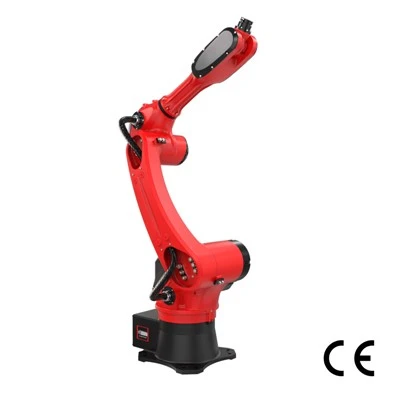
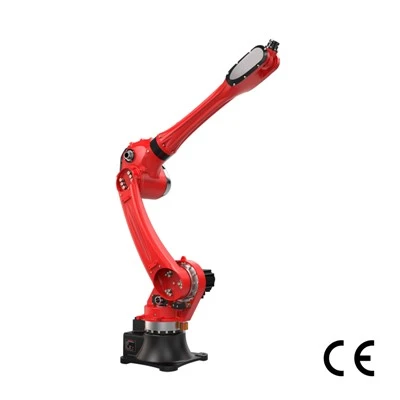
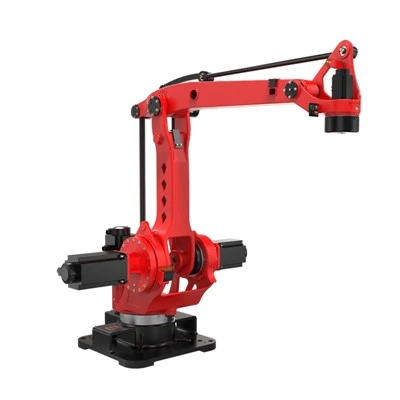
The RBTIC BRTIRWD1506A is a six-axis industrial welding robot with a hollow wrist for internal cable routing and multi-angle torch positioning. It supports robotic welding applications using compatible welding equipment and workpiece handling systems.
Technical Specifications
|
Parameter |
Specification |
|
Model |
BRTIRWD1506A |
|
Robot Axes |
6 |
|
Maximum Arm Reach |
1,647 mm |
|
Rated Payload |
6 kg |
|
Repeatability |
±0.05 mm |
|
Rated Input Capacity |
4.64 kVA |
|
Power Supply |
220 V |
|
Control System |
HC Control System |
|
Robot Weight |
Approx. 166 kg |
|
Mounting Options |
Floor-mounted, side-mounted; riser base optional |
|
Supported Welding Processes |
MIG/MAG, TIG arc welding and spot welding |
|
Compatible Materials |
Carbon steel, stainless steel and aluminum alloy |

Welding Capability
Flexible Torch Movement: Six-axis articulation and a hollow wrist allow the torch to approach joints from different angles, supporting welding on complex part geometries.
Consistent Welding Paths: Programmed robot movements maintain repeatable torch trajectories across production cycles, reducing variation caused by manual torch handling.
Multi-Process Support: MIG/MAG, TIG and spot welding configurations address different joining requirements, depending on the matched welding equipment.


Compatibility & Integration
Installation: Floor-mounted or side-mounted configurations, with an optional riser base.
Workpiece Positioning: Single-axis, double-axis and U-type positioners support different part orientations during welding.
Welding Equipment: Welding power sources, wire feeders, torches and dedicated fixtures can be integrated into the welding cell.
Production-Line Integration: Optional seventh-axis tracks, conveyors and automated loading systems support larger work envelopes and automated material handling.
Seam Detection: Optional 2D laser sensors, 3D vision and seam-tracking systems support applications where joint positions vary between workpieces.
Cell Safety & Auxiliary Equipment: PLC cabinets, safety fencing, fume extraction and torch cleaning equipment can be incorporated into the workstation.

Applications & Workpieces
Pipe Assemblies and Vessels: Robotic welding of circumferential seams and pipe-to-flange joints, with suitable workpiece positioning equipment.
Metal Furniture and Fabricated Frames: Repetitive welds on frames, brackets and structural components.
Electrical Cabinets and Enclosures: Repeated seam welding on sheet-metal panels, cabinet frames and enclosure assemblies.
Material Compatibility: Carbon steel, stainless steel and aluminum alloy, subject to the selected welding process, material thickness and joint design.

Customization Options
Welding Package
MIG/MAG or TIG welding equipment, with compatible torches and wire feeders.
01
Workpiece Tooling
Dedicated fixtures and positioners matched to part dimensions, joint locations and production sequences.
02
Vision & Tracking
Optional laser sensing, 3D vision or seam tracking for applications with variable joint positions.
03
Automation Modules
Seventh-axis tracks, loading and unloading systems, and conveyors for automated production.
04
Auxiliary Equipment
Torch cleaning stations, fume extraction and safety enclosures according to workstation requirements.
05
Quality Assurance & Acceptance
Robot Inspection: Verify the delivered model, payload, reach and repeatability against the specified technical data.
Functional Testing: Check robot motion, controller operation and configured welding-system functions before shipment.
Welding Validation: Conduct sample welding using representative workpieces and agreed weld acceptance criteria when required by the project.
Compliance Documents: Provide applicable CE-related documentation for the supplied equipment, with the scope identified for the robot or complete workstation.
Delivery & Technical Support
|
Lead Time |
7–15 working days for standard robot orders; 15–30 working days for customized welding cells. |
|
Packaging |
Export-standard wooden cases with protective securing for the robot, controller and accessories. |
|
Shipping Documents |
Commercial invoice, packing list and applicable equipment documentation. |
|
Commissioning & Training |
Remote programming guidance, commissioning support and operator training available on request. |
|
Spare Parts |
Replacement parts supplied according to model and availability. |


FAQ
Q: What is the difference between a welding robot and a complete robotic welding system?
A: A welding robot provides the programmed movement, while a complete robotic welding system combines the robot with welding equipment, workpiece fixtures, safety devices and control interfaces. Depending on the production process, positioners, sensors and automated material handling may also be required.
Q: Can an industrial welding robot weld parts with dimensional variations?
A: Yes, within the capabilities of the configured system. Fixed robot programs are best suited to consistently positioned joints. For variable workpiece dimensions or joint locations, touch sensing, laser seam finding or real-time seam tracking may be required. The appropriate solution depends on the size and type of variation.
Q: How do you calculate the cycle time of a robotic welding application?
A: Cycle time includes loading and unloading, fixture clamping, robot travel, actual welding, repositioning and any inspection steps. A reliable estimate requires the weld length, welding parameters, number of welds, workpiece handling sequence and target production quantity. A sample-part trial or offline simulation can help establish a realistic production cycle.
Q: Can a welding robot be integrated into an existing production line?
A: Yes, provided the robot controller, welding equipment, PLC, safety circuits and material-handling systems can communicate and operate together. Integration planning should account for available floor space, workpiece transfer, production signals, safety interlocks and the existing line's operating sequence.
Q: What is required to program a robotic welding job?
A: Programming typically requires the workpiece geometry, weld locations, torch approach angles, welding parameters and fixture positions. Depending on the controller and application, programs can be created through teach-pendant programming or offline programming software. Complex parts may require simulation and collision checking before production.
Q: What information is needed to evaluate a robotic welding project?
A: Prepare 2D drawings or 3D CAD files, material grades and thicknesses, joint types, weld lengths, required weld quality, production volume and target cycle time. Sample workpieces and details of the existing production line can further support feasibility assessment and workstation design.
Q: How can robotic welding quality be validated before mass production?
A: Validation can include sample welding, visual inspection, dimensional checks and application-specific nondestructive testing. Acceptance criteria should be agreed before testing, including the applicable welding procedure, defect limits and any required standards. Test methods depend on the workpiece, joint type and end-use requirements.
Hot Tags: welding industrial robot, China welding industrial robot manufacturers, suppliers, factory