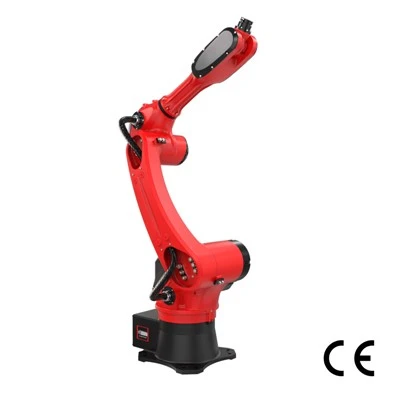
A six-axis industrial robot for welding and material handling – with flexible reach and repeatability, supporting programmed torch orientations for structural fabrication, aluminum guardrails, electrical cabinets, and stainless steel flanges.
Technical Specifications
|
Model |
BRTIRUS2110A |
||
|
Item |
Range |
Max.Speed |
|
|
Arm |
J1 |
±155° |
110°/s |
|
J2 |
-140°/+65° |
146°/s |
|
|
J3 |
-75°/+110° |
134°/s |
|
|
Wrist |
J4 |
±180° |
273°/s |
|
J5 |
±115° |
300°/s |
|
|
J6 |
±360° |
342°/s |
|
|
Arm Length |
2131mm |
||
|
Loading Ability |
10kg |
||
|
Repeatability |
±0.05mm |
||
|
Power Source |
6.48kVA |
||
|
Weight |
About 230kg |
||
|
Control System |
HC Control System |
||

Built Around the Workpiece
The right welding robot depends on part geometry, joint locations, and torch movement space – our extended-reach robot suits larger workpieces:
Covers multiple weld locations on steel frames and assemblies – fixture design and joint access determine actual coverage.
Handles long seams and repeated joints – paths and parameters validated for alloy, thickness, and finish.
Repeatable welding for cabinet frames and sheet-metal assemblies – with access to corners and internal sections.
Evaluated for weld-path coverage around joints – feasibility depends on torch angle, joint prep, and material thickness.
Reach Clearance and Path Planning
Six-Axis Torch Orientation: Flexible torch positioning along programmed paths – angle range depends on joint limits, torch geometry, cable routing, and workpiece arrangement.
Extended Access: 2,131 mm reach provides more options for separated weld locations – final layout checked against the working-envelope drawing.
Fixture & Collision Planning: Fixtures, clamps, and nearby structures restrict movement – simulation identifies access limitations before commissioning.
Repeatable Positioning: ±0.05 mm repeatability supports consistent positioning – actual weld quality also depends on fixtures, tolerances, joint prep, and parameters.
Quality Testing & Calibration Protocol
Trajectory Path Laser Verification: Dynamic speed trajectory testing using multi-axis laser trackers to guarantee true path accuracy (±0.05 mm) during continuous arc motion.
Thermal Expansion Test: 24-hour continuous motion test under simulated heat loading to ensure joint gear stability and zero position drift.
Insulation & Ground Integrity Test: Factory verification of wrist electrical isolation to prevent arc current feedback into servo drives.
Validate the Welding Application Before Investment
What Can Be Evaluated?
- Torch Accessibility: Whether the torch can reach specified joints at required approach angles.
- Fixture Compatibility: Whether the planned workholding allows intended robot paths without interference.
- Welding Feasibility: Whether the selected process and preliminary parameters suit the material and joint design.
- Cycle-Time Estimate: Whether the proposed sequence is consistent with target production rate – subject to testing and process conditions.
What Should You Provide?
- Workpiece drawings or representative samples
- Base material and thickness
- Weld locations and joint specifications
- Required production volume or target cycle time
- Existing welding equipment and fixture details, if applicable

From Project Review to Delivery
Application Assessment
Review workpiece geometry, material, joint requirements, and target output.
Robot and Cell Configuration
Determine the suitable robot setup, welding equipment, fixtures, and required peripherals.
Validation and Quotation
Where required, evaluate sample welding, torch access, and the proposed handling sequence before confirming the configuration.
Production and Inspection
Complete the agreed equipment preparation, integration, and inspection activities according to the purchase scope.
Shipment and Technical Support
Arrange export packaging, shipping documentation, and the agreed technical support services.
Packaging & International Shipping
Protective Export Packaging: Wooden crates with moisture barrier, foam cushioning, and steel strapping – robot arm and controller separately secured. Packaging sized to equipment dimensions (typically 1–3 CBM per unit), confirmed before dispatch.
Shipping Options & Trade Terms: FCL, LCL, air, or sea freight – with EXW/FOB/CIF terms available. Transit times: 5–7 days by air, 15–30 days by sea. Freight costs confirmed during order processing.
Export Documentation: Commercial invoices, packing lists, bills of lading, and certificates of origin prepared per agreed requirements.

FAQ
Q: Is this arm available as a standalone unit without a full welding cell?
A: Yes. We specialize in supplying standalone robot arm manipulators with controllers and teach pendants directly to system integrators, OEMs, and machine builders.
Q: How does the hollow-wrist design benefit our welding cell setup?
A: Internal cable routing completely eliminates torch dress-pack whipping, reduces torch cable fatigue, and allows the arm to enter tight structural spaces without catching cables on fixtures.
Q: What is the production lead time?
A: Standard models: 10–20 working days. Customized configurations: 20–30 working days. Confirmed schedule provided with quotation.
Q: What payment terms are available?
A: Standard terms: 30% T/T deposit to start production, 70% balance before shipment.
Q: What warranty and technical support are provided?
A: Standard warranty: 12 months from delivery – covering manufacturing defects. Technical support includes remote assistance, online troubleshooting, and on-site technician dispatch when required.
Hot Tags: robotic arm for welding, China robotic arm for welding manufacturers, suppliers, factory