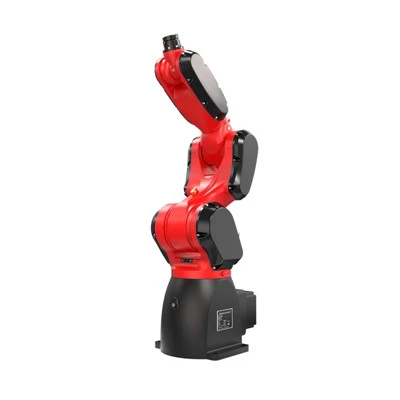
The RBTIC BRTIRUS1510A Machine Tending Robot is a 6-axis industrial robot designed for automated workpiece loading, unloading and transfer in CNC machining operations.
Technical Specifications
|
Parameter |
Specification |
|
Model |
BRTIRUS1510A |
|
Number of Axes |
6 |
|
Rated Payload |
10 kg |
|
Arm Length |
1,587 mm |
|
Repeatability |
±0.05 mm |
|
J1 Range / Max. Speed |
±165° / 190°/s |
|
J2 Range / Max. Speed |
-95° to +70° / 173°/s |
|
J3 Range / Max. Speed |
-85° to +75° / 223°/s |
|
J4 Range / Max. Speed |
±180° / 254°/s |
|
J5 Range / Max. Speed |
±115° / 270°/s |
|
J6 Range / Max. Speed |
±360° / 342°/s |
|
Power Capacity |
5.06 kVA |
|
Power Supply |
220 V |
|
Control System |
HC Control System |
|
Robot Weight |
152 kg |
|
Protection Rating |
IP54 |

Automation Configurations
Two-Machine Cell
One robot serves two CNC machines, alternating loading and unloading according to the machining cycle.
Tray-Based Feeding
Raw workpieces are arranged in defined positions for repeatable robotic pickup.
Part Transfer Between Operations
Moves workpieces between machining stages without manual handling between processes.
Handling Performance
10 kg Rated Payload: Accommodates the workpiece and gripper within the robot's rated payload, defining the load limit for handling applications.
±0.05 mm Repeatability: Maintains consistent robot positioning across repeated loading and unloading cycles.
Six-Axis Articulation: Adjusts gripper orientation to approach workpieces from different angles during pickup and placement.

Working Envelope and Installation
1,587 mm Arm Length: Defines the robot's reach for accessing machine loading points and nearby workpiece stations.
152 kg Robot Weight: Requires a mounting base designed to support the robot and its operating loads.
Cell Clearance: Allow space for full arm movement, gripper travel, CNC door access and maintenance.

Compatibility
CNC Lathes: Suitable for automated loading and unloading of turned parts weighing within the robot's 10 kg rated payload, including the gripper. The 1,587 mm arm length supports part transfer between the loading position and the lathe chuck within the working envelope.
CNC Machining Centers: Supports automated workpiece loading and unloading at machining fixtures within the robot's reach, suitable for repetitive milling, drilling and other CNC machining operations.
Two-Machine Tending: Can serve two CNC machines in one automation cell when both machine access points fall within the robot's working envelope and the combined machining cycles allow sufficient time for loading and unloading.
Applications
Shaft and Pin Turning: Loads cylindrical blanks and unloads finished drive shafts, steel pins and stepped shafts.
Automotive Component Machining: Handles bushings, bearing sleeves and transmission components during CNC processing.
Bracket and Housing Milling: Loads metal brackets, mounting blocks and small equipment housings into machining-center fixtures.
Opposite-End Machining: Transfers shafts between operations to machine the second end after the first-end process.
Maintenance
Joint Maintenance: Follow the prescribed lubrication and inspection intervals for robot joints.
Cable and Connector Inspection: Check for wear, damage and loose connections.
Mounting and Gripper Inspection: Check mounting bolts, gripper fasteners and end-effector connections.
Preventive Servicing: Follow the model-specific maintenance schedule and replace service parts at the specified intervals.
Project Requirements
Workpiece: Part dimensions, weight, material and representative drawings or photos.
CNC Equipment: Machine make and model, chuck or fixture position, and available control interface.
Production Target: Required cycle time, production volume and number of part types.
Automation Layout: Number of machines, raw-part supply position and finished-part collection location.
FAQ
Q: What programming methods are available for the BRTIRUS1510A CNC robot?
A: Programming methods depend on the supplied HC Control System configuration. Confirm the available teaching interface, program editing functions and support for storing and switching between part programs before ordering.
Q: Can a CNC machine tending robot switch between different production batches?
A: Yes, batch changeovers can be supported when the required robot programs, gripper arrangements and machine fixtures are available. The changeover procedure and additional tooling requirements depend on the differences between workpiece models.
Q: Can the BRTIRUS1510A support unattended CNC production?
A: Unattended operation requires more than the robot itself. The automation cell needs reliable raw-part supply, finished-part collection, machine-status monitoring, fault recovery and appropriate safety measures to manage operation without continuous operator intervention.
Q: What safety equipment is required for a CNC robot cell?
A: Depending on the risk assessment and cell layout, the system may require perimeter guarding, interlocked access doors, emergency stops and coordinated safety functions for the robot and CNC machine. The required configuration should be defined before installation.
Q: What should be included in the acceptance test for a CNC tending robot?
A: Define acceptance criteria before ordering, including successful loading and unloading, repeatable part placement, machine signal coordination, fault handling and the required production cycle. Test conditions should reflect the actual workpiece, gripper and CNC process.
Q: What spare parts and technical support should buyers request?
A: Ask for the recommended spare-parts list, maintenance documentation, controller and program backup procedures, warranty terms and technical support scope. These details help estimate long-term maintenance needs and reduce uncertainty when production stops.
Hot Tags: machine tending robot, China machine tending robot manufacturers, suppliers, factory